
The Science of Motion Sensors: Why Radar Detection is Better Than PIR
Understanding Motion Detection Technology in Solar Street Lights
When you're shopping for outdoor lighting that won't spike your electricity bill, you've probably noticed that most solar street lights come with motion sensors. But here's something most people don't realize: not all motion sensors are created equal. The difference between radar detection and PIR (Passive Infrared) sensors can mean the difference between a light that works flawlessly in all conditions and one that leaves you frustrated on cold winter nights.
If you're considering an off-grid lighting solution with no wiring required, understanding these technologies isn't just technical jargon—it's the key to making a smart investment that actually delivers on the promise of zero electricity bills and reliable security.

What Actually Happens When Motion Sensors Detect Movement
Let's start with the basics. Both PIR and radar sensors exist to save energy by only turning your lights on when someone's actually there. This is especially critical for solar-powered lights because battery capacity is precious. You want your solar street lights to last through the night, not burn out at 2 AM because they've been running at full brightness since sunset.
How PIR Sensors Work: The Heat Detective
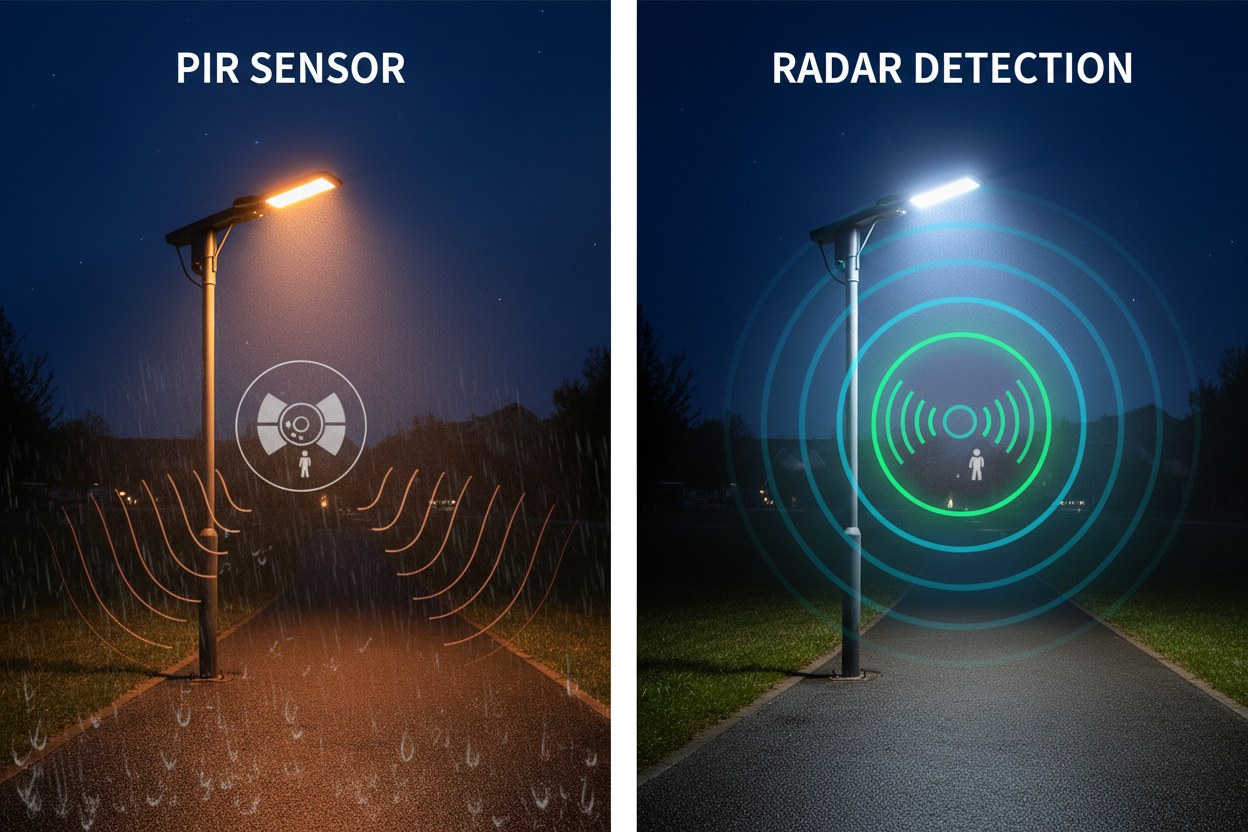
PIR sensors are essentially heat detectors. They work by sensing infrared radiation—the heat signature that all living things emit. When you walk into the detection zone, your body heat creates a change in the infrared pattern, and boom, the light switches on.
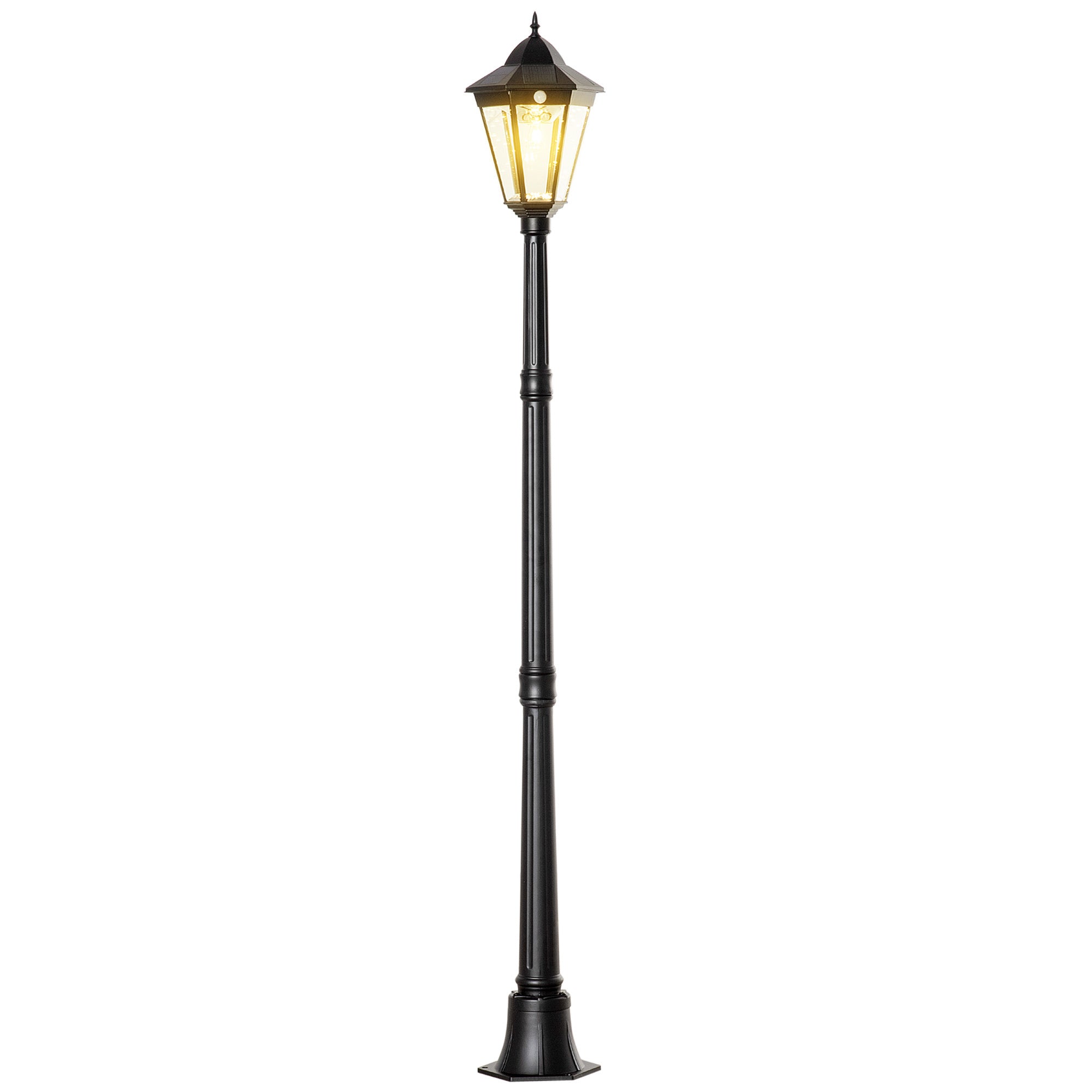
This technology has been around since the 1970s and it's cheap to manufacture, which is why you'll find it in everything from basic security lights to those annoying automatic paper towel dispensers in public restrooms. For DIY installation projects where budget matters, PIR-equipped lights like the 77-inch Solar Lamp Post Light ($266.99) offer an accessible entry point into motion-activated outdoor lighting.
How Radar Sensors Work: The Movement Specialist
Radar detection takes a completely different approach. Instead of waiting to sense heat, radar sensors actively emit microwave signals and measure how those signals bounce back. When something moves in the detection zone, it changes the frequency of the returning waves (this is called the Doppler effect—the same principle that makes an ambulance siren sound different as it passes you).
This active sensing method gives radar sensors some serious advantages that we'll dig into, but first, let's talk about why this matters for your specific situation.
The Real-World Problems PIR Sensors Can't Solve
Here's where theory meets reality. PIR sensors have some fundamental limitations that become painfully obvious once you've installed them in certain environments.
Temperature Sensitivity: When Cold Weather Kills Detection
Remember how PIR sensors detect heat differences? Well, that becomes a problem when the ambient temperature gets close to human body temperature. On a scorching summer day when the pavement is 95°F and your body is 98.6°F, that's only a 3.6-degree difference for the sensor to detect. The sensor's sensitivity drops dramatically.
But the bigger issue is cold weather. When temperatures drop below freezing, you'd think detection would improve (bigger temperature difference, right?). Sometimes it does. But here's the catch: PIR sensors themselves slow down in cold temperatures. The pyroelectric crystals inside them become less responsive. This is why your motion-activated light might work perfectly in October but start missing detections in January.
For anyone living in northern states or areas with harsh winters, this isn't a minor inconvenience—it's a security risk. Your off-grid lighting system needs to work when you need it most, not just when the weather cooperates.
The Line-of-Sight Problem
PIR sensors require a clear, unobstructed view of the detection area. That sounds reasonable until you consider real-world conditions:
- Heavy rain creates a curtain of water droplets that can block infrared radiation
- Fog and mist scatter infrared signals before they reach the sensor
- Dust, pollen, and spider webs on the sensor lens dramatically reduce sensitivity
- Glass, plastic, and even some types of weather-resistant covers can block infrared
This is why you'll sometimes see PIR lights that don't trigger when you walk by, even though you're clearly in range. Something's blocking the infrared signal, and the sensor is essentially blind.
Detection Range Limitations
Most PIR sensors in solar street lights have an effective range of about 20-30 feet under ideal conditions. But "ideal conditions" rarely exist. That range shrinks considerably when:
- The target is moving slowly (PIR sensors detect movement, not presence)
- The target is moving directly toward or away from the sensor (PIR works best with lateral movement)
- Environmental conditions aren't perfect
- The sensor is mounted at the wrong angle
For pathway lighting or driveway applications where you want early detection so the light is already on when you arrive, these limitations matter.

Why Radar Detection Changes Everything
Now let's talk about why radar-equipped solar lights represent a genuine technological upgrade, not just marketing hype.
All-Weather, All-Temperature Performance
Microwave radar signals don't care about temperature. They work exactly the same at -20°F as they do at 110°F. Rain, fog, dust, snow—none of it significantly affects radar detection. The microwave signals pass right through these obstacles.
This is why the Rackora Moon-Inspired Solar Street Light with radar detection (starting at $69) can maintain consistent performance year-round. Whether you're dealing with summer thunderstorms or winter blizzards, the radar sensor keeps working.
For off-grid installations where you can't easily access the light for troubleshooting, this reliability is worth its weight in gold.
Superior Detection Range and Accuracy
Radar sensors typically offer detection ranges of 30-50 feet or more, and that range remains consistent regardless of environmental conditions. But it's not just about distance—it's about accuracy.
Radar can detect:
- Slower movements that PIR might miss
- Movement in any direction (not just lateral)
- Multiple targets simultaneously
- Movement through certain materials (like thin walls or vegetation)
This means fewer false negatives (times when the light should turn on but doesn't) and better overall security coverage.
Adjustable Sensitivity Without Physical Access
Here's a practical advantage that doesn't get enough attention: many radar-equipped lights allow you to adjust sensitivity settings remotely or through a control panel. With PIR sensors, if you're getting too many false triggers from tree branches or too few triggers from actual people, your options are limited—usually involving physically repositioning the light or covering part of the sensor.
The Rackora Portable Solar Security Light ($369) with advanced radar motion sensor offers this kind of flexibility, making it ideal for DIY installation where you might need to fine-tune settings after setup.

Reduced False Triggers
PIR sensors are notorious for false triggers. Small animals, wind-blown debris, even sudden temperature changes from clouds passing over can set them off. Each false trigger wastes precious battery power—a critical concern for solar lights operating with zero electricity bills.
Radar sensors can be calibrated to ignore small objects and only respond to human-sized targets. This dramatically reduces false triggers while maintaining security effectiveness.
The Energy Efficiency Equation: Why It Matters for Solar
Let's talk about something that doesn't get enough attention in motion sensor discussions: energy consumption of the sensor itself.
PIR sensors are passive—they don't emit anything, they just listen for infrared radiation. This makes them extremely energy-efficient, typically drawing only 0.1-0.2 watts. For a solar light with a limited battery capacity, this is a significant advantage.
Radar sensors, because they actively emit microwave signals, consume more power—typically 0.5-2 watts depending on the model and settings. That might not sound like much, but over a 12-hour night, it adds up.
So why would you choose radar if it uses more power? Because modern solar lights with radar detection compensate for this in two ways:
- Larger battery capacity: Lights designed for radar typically include bigger batteries to handle the extra draw
- More efficient LEDs and solar panels: The overall system is engineered to maintain zero electricity bills despite the sensor's higher consumption
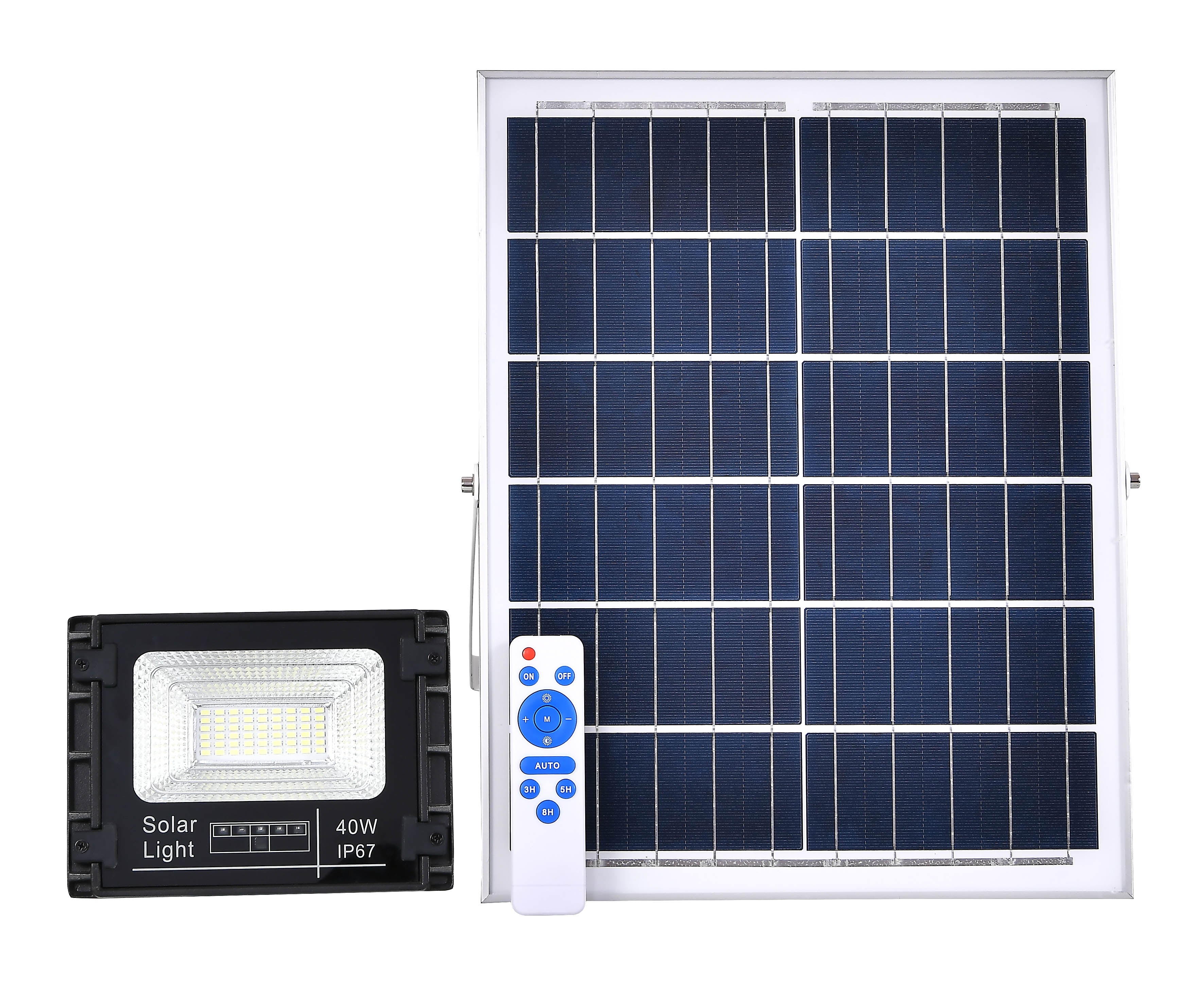
The Rackora LiFePO4 Solar Flood Light ($69.99) demonstrates this approach with its 40,000mAh battery capacity and intelligent brightness curve that maximizes runtime while maintaining motion detection capabilities.
Installation Considerations: No Wiring Doesn't Mean No Planning
One of the biggest selling points of solar street lights is DIY installation with no wiring required. But the type of motion sensor you choose affects how you should approach installation.
Mounting Height and Angle for PIR
PIR sensors are picky about mounting angles. Mount them too high, and they might not detect people walking directly underneath. Mount them too low, and you'll get constant false triggers from small animals. The sweet spot is usually 6-10 feet high, angled slightly downward.
You also need to consider what's in the background. PIR sensors work best when there's a clear temperature contrast between the target and the background. A sensor pointed at a sun-heated wall might struggle to detect someone walking in front of it.
Mounting Flexibility with Radar
Radar sensors are more forgiving. They can be mounted higher (up to 15-20 feet) without losing effectiveness, and they're less sensitive to background conditions. This gives you more flexibility in placement, which is especially valuable for off-grid installations where you're limited by where you can safely mount the light.
The portable design of some radar-equipped lights, like the Flying Saucer model mentioned earlier, takes this even further—you can position them exactly where you need coverage without worrying about wiring or permanent mounting.
Avoiding Detection Dead Zones
Both sensor types have blind spots, but they're different:
PIR blind spots:
- Directly underneath the sensor (if mounted overhead)
- Areas blocked by obstacles
- Zones where movement is directly toward/away from the sensor
Radar blind spots:
- Directly underneath (though smaller than PIR)
- Behind metal objects or dense concrete (radar can't penetrate these)
Understanding these limitations helps you plan your DIY installation for maximum coverage.
Cost Analysis: Is Radar Worth the Premium?
Let's address the elephant in the room: radar-equipped solar lights typically cost 20-40% more than comparable PIR models. Is that premium justified?
Consider the total cost of ownership over 5 years:
PIR Solar Light:
- Initial cost: $200 (example)
- Potential replacement due to weather-related failure: $200 (year 3)
- Electricity cost: $0 (solar)
- Maintenance: Minimal
- Total: $400
Radar Solar Light:
- Initial cost: $280 (example, 40% premium)
- Replacement: Unlikely due to all-weather reliability
- Electricity cost: $0 (solar)
- Maintenance: Minimal
- Total: $280
This is obviously simplified, but it illustrates an important point: the higher upfront cost of radar can be offset by better reliability and longer service life, especially in challenging climates.
For critical security applications—like lighting a remote driveway or illuminating a pathway where falls could cause injury—the reliability advantage of radar might be worth far more than the cost difference.
Hybrid Systems: Getting the Best of Both Worlds
Some advanced solar lights now incorporate both PIR and radar sensors in a hybrid configuration. The PIR sensor handles close-range detection (where it excels and uses minimal power), while the radar sensor monitors longer ranges and difficult conditions.
This approach optimizes battery life while maintaining reliable detection. It's more expensive, but for high-priority installations, it might be the ideal solution.
Real-World Applications: Which Sensor for Which Situation?
Let's get practical. Here's when to choose each technology:
Choose PIR When:
- You're in a mild climate with minimal temperature extremes
- The installation is in a protected area (under an eave, in a covered walkway)
- Budget is the primary concern
- Detection range of 20-25 feet is sufficient
- You can easily access the light for maintenance and adjustment
The Rackora 3-Head Solar Wall Light ($49.99) with PIR sensor is perfect for these scenarios—it offers excellent value for protected installations where weather extremes aren't a concern.
Choose Radar When:
- You experience harsh weather (extreme cold, heavy rain, snow, fog)
- The installation is in an exposed location
- You need longer detection range (30+ feet)
- Reliability is more important than initial cost
- The light will be difficult to access for maintenance
- You need detection through light obstacles (vegetation, thin barriers)
For these demanding applications, investing in radar-equipped models like the Moon-Inspired Solar Street Light ensures consistent performance regardless of conditions.
The Future of Motion Detection in Solar Lighting
The technology isn't standing still. Here's what's coming:
AI-Enhanced Detection
Next-generation systems are incorporating machine learning to distinguish between different types of movement—human, vehicle, animal, or environmental. This will virtually eliminate false triggers while improving security.
Mesh Networking
Imagine multiple solar lights communicating with each other, creating a coordinated detection network. When one light detects movement, it can alert others to prepare, creating a wave of illumination that follows people through an area. This is already appearing in high-end commercial systems and will eventually trickle down to residential products.
Improved Energy Efficiency
Radar sensors are becoming more energy-efficient with each generation. Within a few years, the power consumption difference between PIR and radar will be negligible, making radar the obvious choice for most applications.
Making Your Decision: A Practical Framework
Here's a simple decision framework to help you choose:
- Assess your climate: Harsh weather = radar. Mild climate = PIR is fine.
- Define your detection needs: Long range or obstacle penetration = radar. Standard range = PIR works.
- Consider accessibility: Hard to reach = radar for reliability. Easy access = PIR acceptable.
- Evaluate your budget: If the 30-40% premium for radar strains your budget, PIR can work in the right conditions.
- Think long-term: For permanent installations, radar's reliability might save money over time.
Installation Tips for Maximum Performance
Regardless of which sensor type you choose, follow these guidelines for optimal performance:
For PIR Sensors:
- Mount 6-10 feet high for best coverage
- Angle downward 15-20 degrees
- Keep the sensor lens clean—check monthly
- Avoid pointing at heat sources (AC units, dryer vents)
- Position for lateral movement detection when possible
- Test in different weather conditions after installation
For Radar Sensors:
- Can mount higher (10-15 feet) without losing effectiveness
- Avoid pointing directly at metal surfaces
- Adjust sensitivity settings after installation based on actual performance
- Consider detection range when positioning—more isn't always better
- Use remote control features to fine-tune without climbing
Maintenance and Troubleshooting
Common PIR Issues and Solutions:
Problem: Light doesn't trigger when you walk by
- Check for obstructions blocking the sensor
- Clean the sensor lens
- Verify the sensor isn't pointed at a heat source
- Test in different weather—cold weather can reduce sensitivity
Problem: Constant false triggers
- Reduce sensitivity if adjustable
- Check for heat sources in the detection zone
- Look for moving vegetation or other environmental triggers
- Consider repositioning the light
Common Radar Issues and Solutions:
Problem: Reduced detection range
- Check for metal objects in the detection path
- Verify power supply (low battery can reduce radar power)
- Adjust sensitivity settings
- Ensure the sensor isn't pointed at dense concrete or metal
Problem: Too sensitive (triggers too easily)
- Reduce sensitivity through settings
- Adjust detection range if possible
- Reposition to avoid high-traffic areas if appropriate

The Bottom Line: Which Technology Wins?
There's no universal answer—it depends on your specific situation. But here's the honest truth: radar detection represents a genuine technological advancement that solves real problems PIR sensors can't handle.
If you live in an area with harsh weather, need reliable long-range detection, or are installing lights in locations where maintenance is difficult, radar is worth the premium. The improved reliability and consistent performance justify the higher initial cost.
If you're in a mild climate, installing in protected locations, and working with a tight budget, quality PIR sensors can absolutely meet your needs. Don't let anyone tell you PIR is obsolete—it's still the right choice for many applications.
The key is understanding the trade-offs and choosing based on your actual requirements, not marketing hype or arbitrary budget constraints.
For most people reading this, the sweet spot is probably a radar-equipped solar light for primary security applications (driveway, main entrance, dark pathways) and PIR-equipped lights for secondary locations (side yards, garden paths, decorative lighting).
This hybrid approach gives you reliable performance where it matters most while keeping overall costs reasonable.
Ready to Upgrade Your Outdoor Lighting?
Whether you choose PIR or radar, the most important decision is moving away from traditional wired lighting to solar-powered, motion-activated systems. The combination of no wiring, zero electricity bills, and DIY installation makes solar street lights one of the smartest home improvements you can make.
Rackora's range of solar lighting solutions includes both PIR and radar-equipped models, all designed for reliable off-grid performance. From budget-friendly options to premium radar-equipped systems, there's a solution for every application and budget.
The technology is mature, the prices are reasonable, and the benefits are real. The only question is: which sensor technology is right for your specific needs?
Now you have the information to make that decision confidently.
Frequently Asked Questions
Why does my PIR motion sensor light stay on longer than it should?
PIR sensors typically have a timer that keeps the light on for a set period after detecting motion (usually 30 seconds to 5 minutes). If your light stays on longer, it's likely detecting continuous motion—this could be wind-blown vegetation, small animals, or even temperature changes from heating/cooling equipment. Check for environmental triggers in the detection zone and adjust sensitivity if possible. Radar sensors can be calibrated to ignore these false triggers more effectively.
Can motion sensor solar lights work in freezing temperatures?
Yes, but performance varies by sensor type. PIR sensors can become less responsive in extreme cold as the pyroelectric crystals slow down. Radar sensors maintain consistent performance regardless of temperature. If you live in an area with harsh winters, radar-equipped lights like the Rackora Moon-Inspired Solar Street Light offer more reliable cold-weather operation. Also ensure your solar light uses lithium batteries (not lead-acid) as they perform better in cold conditions.
How far can motion sensors detect movement?
PIR sensors typically detect movement up to 20-30 feet under ideal conditions, though this range decreases in poor weather or when the sensor is dirty. Radar sensors offer 30-50+ feet of consistent detection range regardless of weather conditions. The effective range also depends on mounting height, angle, and whether the movement is lateral (best for PIR) or approaching (better for radar). For maximum coverage, position your light to detect lateral movement when possible.
Do solar motion sensor lights work through windows or glass?
PIR sensors cannot detect through glass because glass blocks infrared radiation. This is why indoor PIR sensors won't trigger from movement outside a window. Radar sensors can detect through glass and other non-metallic materials, though the signal strength is reduced. If you need to detect movement through a barrier, radar is your only option. For outdoor installations, this usually isn't a concern, but it matters for lights mounted inside looking out.
What's the best motion sensor for detecting slow-moving targets?
Radar sensors excel at detecting slow movement because they measure actual motion via the Doppler effect. PIR sensors struggle with slow movement because they rely on rapid changes in infrared patterns—someone moving very slowly might not create enough change to trigger the sensor. This is why PIR lights sometimes don't activate when you're moving slowly, but immediately trigger when you wave your hand quickly. For applications where slow movement detection matters (elderly residents, careful wildlife observation), choose radar.
How do I reduce false triggers from small animals?
For PIR sensors, mount the light higher (8-10 feet) and angle it downward—this reduces sensitivity to ground-level movement. Some PIR sensors have adjustable sensitivity; reduce it until small animals no longer trigger the light. Radar sensors can be calibrated to ignore objects below a certain size threshold, making them inherently better at filtering out small animals while still detecting humans. The Rackora radar-equipped models offer this adjustability through remote control settings.
Can I install motion sensor solar lights myself without any electrical experience?
Absolutely—this is one of the biggest advantages of solar lights. With no wiring required, DIY installation typically involves just mounting the light securely and positioning it for optimal sun exposure and detection coverage. Most solar lights come with mounting hardware and clear instructions. The key is choosing the right location: south-facing for maximum solar charging (in the Northern Hemisphere), at the appropriate height for your sensor type, and angled correctly for detection. No electrical permits or professional installation needed.
How long do motion sensor solar lights last on a full charge?
This varies significantly based on battery capacity, LED efficiency, and how often the motion sensor triggers. Quality solar lights like Rackora's models typically offer 12-18 hours of runtime with intelligent brightness management—full brightness when motion is detected, then dimming to conserve power. Lights with larger batteries (like the 12,000mAh Flying Saucer model) can maintain performance even after several cloudy days. Radar sensors consume slightly more power than PIR, but modern systems compensate with larger batteries and more efficient LEDs to maintain zero electricity bills.
What happens to solar motion lights during extended cloudy periods?
Quality solar lights include battery capacity for 2-3 days of operation without sunlight. During extended cloudy periods, the lights will still charge (solar panels work in diffuse light, just less efficiently) but may not reach full capacity. Most lights will automatically reduce brightness or runtime to extend battery life. Lights with larger battery capacity and efficient LEDs perform better during cloudy stretches. If you live in an area with frequent extended cloudy periods, choose lights with higher battery capacity (40,000mAh+) and consider supplementing with occasional manual charging if the system allows it.
Are radar motion sensors safe? Do they emit harmful radiation?
Yes, radar motion sensors are completely safe. They emit low-power microwave signals at frequencies and power levels far below anything that could cause harm—typically 1/1000th the power of a cell phone. These sensors have been used in automatic doors, security systems, and automotive applications for decades with no health concerns. The microwave emissions are non-ionizing (unlike X-rays) and are regulated by the FCC to ensure safety. You're exposed to far more microwave radiation from your WiFi router or cell phone than from a radar motion sensor.